Contracts for Difference (CFD) trading has grown into one of the most popular financial instruments in the world, offering traders the opportunity to speculate on price movements across forex, stocks, indices, and commodities – without owning the underlying asset. However, with rising popularity comes an increased risk, and CFD trading scams have surged in parallel with market growth. Whether you are a seasoned investor or a beginner exploring high-leverage trading, understanding how these scams operate is the first step toward protecting your capital and making informed decisions.
This article provides a practical, in-depth overview of how CFD trading fraud works, what warning signs to look for, and how victims can take action. If you have ever searched “is CFD trading a scam” or wondered whether your broker is legitimate, this guide is for you.
The Rise of CFD Trading Scams: What You Need to Know
The contract for difference scam landscape has evolved rapidly over the past decade. Sophisticated fraudsters have moved beyond crude schemes, now building convincing trading platforms, hiring fake support staff, and using social media to recruit victims. According to financial watchdogs across Europe, the US, Australia, and Asia, losses from unregulated CFD broker scams now run into billions of dollars annually.
Many of these scam operations are based offshore – outside the reach of mainstream regulators – making recovery difficult. Offshore CFD broker fraud typically involves companies registered in loosely regulated jurisdictions that pose as legitimate brokers, accept deposits, and then make withdrawal nearly impossible.
The problem is not limited to CFDs alone. Broader online financial fraud – including types of scams such as binary options and CFD scams, forex and CFD scam brokers, and high leverage trading scams – shares overlapping tactics. Understanding the common architecture of these schemes is essential for every investor.
What Are the Common Signs of CFD Trading Scams?
Identifying a CFD investment scam warning sign early can save you from devastating losses. Scammers are skilled at mimicking legitimate financial services, but their schemes tend to follow recognizable patterns. Here are the most common red flags:
1. Unrealistic Profit Guarantees
Legitimate CFD brokers do not guarantee returns. If a platform or representative promises consistent daily or weekly profits – especially on high leverage trading – treat it as a serious red flag. Real markets are volatile and unpredictable. No honest broker will promise you a fixed return.
2. Unregulated or Fake Regulatory Claims
Fake CFD trading platforms commonly display fraudulent regulatory logos – claiming to be licensed by the FCA, ASIC, CySEC, or other bodies when they are not. Always verify regulatory claims directly on the official regulator’s website. A broker that claims to be regulated but cannot be verified independently should be treated with extreme caution.
3. Withdrawal Refusals and Delays
One of the clearest indicators of a CFD broker scam is the refusal or indefinite delay of withdrawals. Scam platforms may approve your trading profits on screen, but make it impossible to actually access your funds. They may cite “verification issues,””tax compliance,” or invented fees that must be paid before releasing funds.
If you are facing withdrawal issues, document every interaction and consider reporting the incident to a CFD fraud recovery expert.
4. Pressure Tactics and Urgency
Scammers frequently use high-pressure sales tactics to push investors to deposit more money, especially after initial losses. Phrases like “this is a limited-time opportunity” or “you need to add funds now to recover your position” are manipulation techniques designed to bypass rational decision-making.
5. No Physical Address or Verifiable Contact Information
Legitimate financial firms have verifiable addresses, phone numbers, and regulatory registration numbers. Unregulated CFD broker scams typically offer only a web form, a generic email address, or a virtual office address that cannot be confirmed. Always research a broker’s physical location and verify it independently before depositing any funds.
7 Warning Signs of a CFD Trading Scam
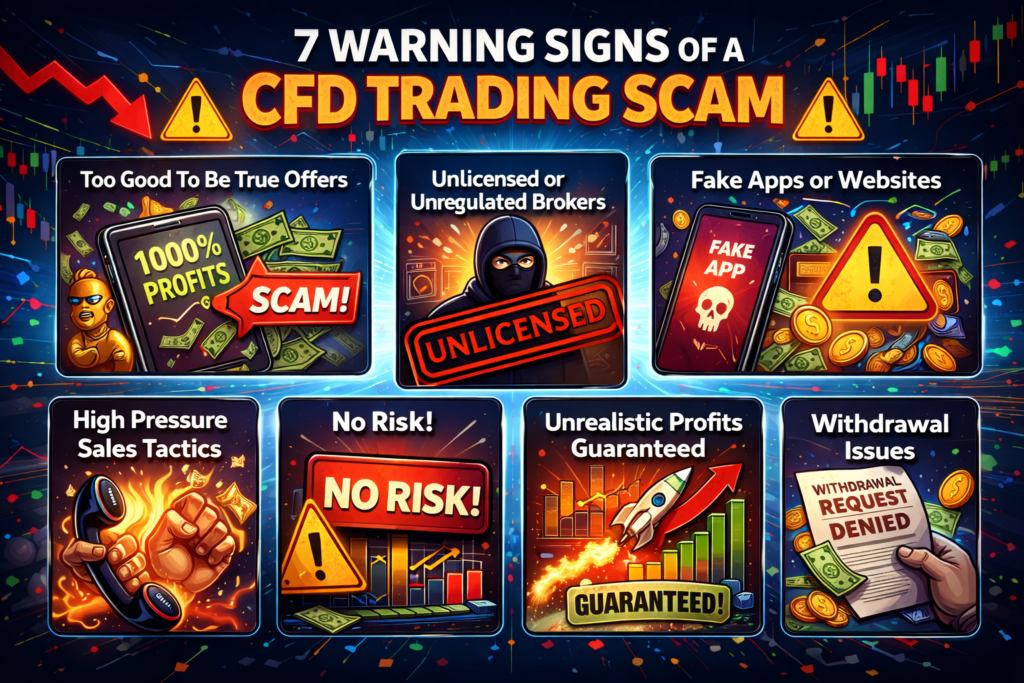
To make it easy to identify danger, here are seven concrete warning signs that should prompt further investigation before you proceed:
- The platform promises fixed or guaranteed returns from CFD or forex trading.
- The broker cannot be verified on any official regulatory register.
- You are contacted out of the blue via social media, messaging apps, or cold calls.
- Withdrawal requests are consistently delayed or denied without a clear explanation.
- You are asked to pay additional “fees” or “taxes” before receiving your profits.
- The platform shows unusually consistent profits that seem too good to be real.
- The company has limited or no online presence outside its own website.
If you recognize two or more of these warning signs, you may be dealing with a CFD investment scam. Users can securely report suspicious CFD trading activity to financial regulators or dedicated reporting services. Early reporting can help prevent further losses.
Understanding the Dangers of CFD Trading Scams
CFD trading is not inherently a scam – it is a legitimate financial instrument offered by regulated brokers around the world. However, the high-leverage nature of CFD trading, combined with the complexity of derivatives markets, makes it an attractive area for fraudsters to exploit. Many victims report losing their entire savings through platforms that appeared professional and credible at first glance.
The psychological impact on victims is significant. Beyond the financial loss, victims of CFD trading fraud often experience shame, anxiety, and reluctance to report the incident, which is exactly what scammers rely on. It is important to understand that these are sophisticated operations designed to deceive even experienced investors. Being victimized is not a reflection of intelligence or financial literacy.
This same dynamic affects victims across various online financial frauds. Just as there are well-documented guides on topics like a step-by-step guide to protecting yourself from crypto scams or understanding why forex scams target investors, the CFD space requires its own dedicated awareness framework – because the tactics, while overlapping, carry unique characteristics tied to leverage, margin calls, and contract structures.
8 Common Tactics Used by CFD Trading Scammers
Understanding how scammers operate empowers investors to recognize manipulation before it is too late. Here are eight tactics commonly used in CFD trading fraud:
1. Fake Trading Platforms
Scammers build fake CFD trading platforms that mimic legitimate brokers. These platforms show fabricated charts, fake profit figures, and simulated trading activity. The underlying technology may not connect to real markets at all.
2. Impersonation of Regulated Brokers
Fraudsters clone the websites of real, regulated brokers – copying logos, design, and branding – to deceive investors into trusting them. Always access broker websites directly by typing the URL, never through links in unsolicited messages.
3. Managed Account Fraud
Victims are convinced to hand over control of their trading accounts to a “professional trader” who promises to generate returns on their behalf. This is often combined with fabricated performance results to build initial trust.
4. Romance and Social Engineering
Scammers establish romantic relationships or fake friendships online before introducing their “investment opportunity.” This is sometimes called pig butchering. Victims of these schemes often ask: How can you report a romance scam if it also involved investment fraud? The answer is to report to both financial regulators and relevant law enforcement simultaneously.
5. Phishing and Spoofed Communications
Investors receive emails or messages that appear to come from their broker, directing them to fake login pages designed to steal credentials. Understanding the ultimate guide to preventing phishing scams is particularly relevant here – always verify sender addresses and avoid clicking links in financial emails.
6. Bonus and Promotion Traps
Many fake platforms offer attractive deposit bonuses – such as “100% match on your first deposit” – that come with hidden terms, making it impossible to withdraw any funds until trading volumes far exceeding the bonus amount are reached.
7. Binary Options Crossover Schemes
Binary options and CFD scams often overlap, with fraudulent operators offering both instruments on the same platform. Binary options are banned in many jurisdictions precisely because of their abuse by scammers – their presence on a CFD platform is a strong warning signal.
8. Recovery Scams
After a victim has already lost money, a secondary scammer – sometimes posing as a law firm or recovery specialist – contacts them, claiming they can retrieve lost funds for an upfront fee. These are known as recovery scams and compound the original loss. Seek only credible, verifiable assistance when exploring CFD scam fund recovery services.
Who Is Most Likely to Fall Victim to CFD Trading Scams?
CFD trading fraud does not discriminate by age, education, or income. However, certain groups are statistically more vulnerable:
- Beginners are attracted by the promise of quick profits, but have limited knowledge of leverage risk and market mechanics.
- Retirees and those with savings who are seeking better returns than traditional investments offer.
- Investors who have experienced prior losses and are seeking a way to recover are making them susceptible to “guaranteed return” pitches.
- Social media users are approached by convincing influencer-style accounts promoting trading platforms with lifestyle imagery.
If you suspect a CFD trading broker is misleading you, consider reporting it to a relevant financial authority in your country. The sooner a suspicious broker is reported, the greater the chance of preventing harm to others.
Why Do CFD Trading Scams Continue to Thrive?
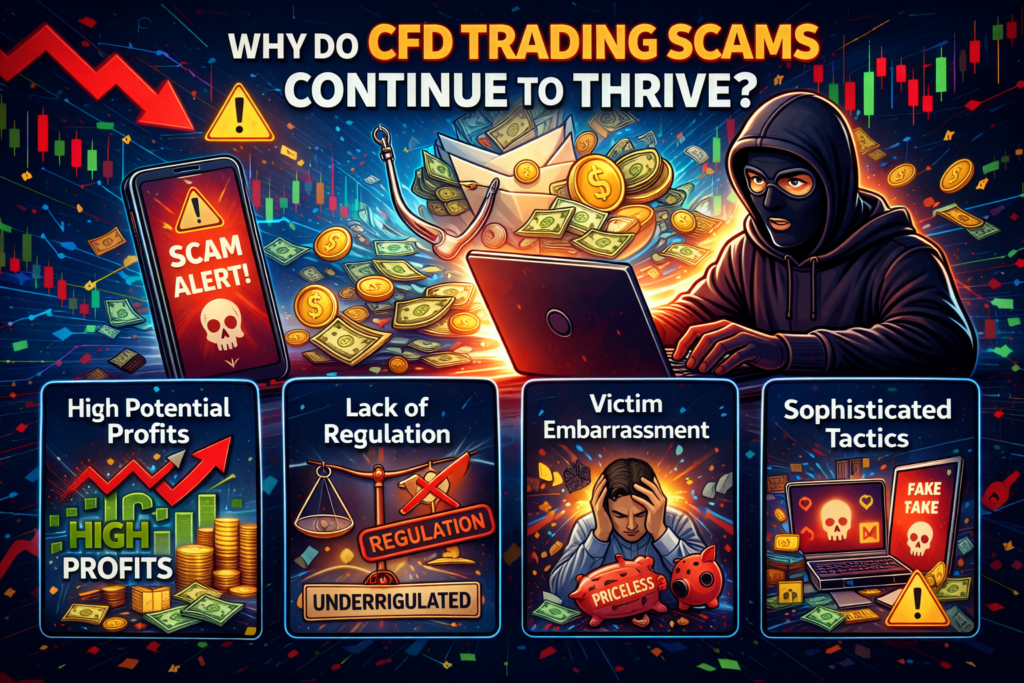
Despite growing awareness and regulatory crackdowns, CFD trading fraud continues to proliferate for several key reasons. First, the global and digital nature of these operations makes jurisdictional enforcement difficult. A scam broker registered in a Caribbean offshore jurisdiction accepting clients from Europe and Asia is challenging for any single regulator to pursue effectively.
Second, scammers continually adapt. The same operators behind shuttered platforms often relaunch under new names and domains within weeks. Third, victim silence plays a major role – many people who lose money to CFD investment scams do not report the incident out of embarrassment or because they believe nothing will come of it.
This is why reporting matters so much. Similar dynamics sustain other forms of digital financial crime – from questions about where to report Bitcoin scams to filing complaints about fraudulent forex platforms. Every report adds to a body of evidence that regulators and investigators can act upon.
How to Spot Red Flags in CFD Trading: A Guide
Before opening an account with any CFD broker, the following checklist can help you assess legitimacy:
Verify Regulatory Status
Check the broker’s regulatory status on the official register of your country’s financial regulator (e.g., FCA in the UK, ASIC in Australia, CFTC/NFA in the US, CySEC in Cyprus). Verify the exact company name and registration number – not just the logo displayed on their website.
Research the Broker’s History
Search for the broker’s name combined with terms like “scam”, “complaint,””withdrawal issue,” or “review” on independent forums and financial watchdog databases. Consistent negative patterns are significant red flags.
Understand the Fee and Withdrawal Structure
Legitimate brokers have clearly documented fee structures and transparent withdrawal processes. If a broker’s terms and conditions are vague, difficult to find, or require you to pay fees not disclosed upfront before withdrawing, this is a serious concern.
Test With a Small Amount First
If you decide to trial a new platform, deposit the minimum possible amount and immediately test the withdrawal process before investing further. A legitimate broker will process your withdrawal without issue. If the withdrawal is delayed or conditions are added after the fact, halt further activity and report the incident.
Where Can You Report CFD Trading Scams?
Knowing where to report CFD trading scam activity online is a critical part of the victim’s response. Here are the primary channels:
National Financial Regulators
Every country with a formal financial system has at least one regulatory body that accepts complaints about unauthorized or fraudulent financial firms. Examples include the FCA (UK), ASIC (Australia), SEC and CFTC (USA), BaFin (Germany), and AMF (France). File a complaint against CFD broker activity through the official complaint portal of the relevant regulator.
Consumer Protection Agencies
Agencies such as Action Fraud (UK), the FTC (US), or equivalent bodies in other countries accept reports of financial fraud. These reports feed into national databases used by law enforcement.
Dedicated Online Reporting Services
Specialized platforms like TruClaim focus on CFD fraud recovery case review allow victims to submit detailed accounts of their experiences. These services compile evidence, help identify scam patterns, and connect victims with appropriate professionals for further guidance. If you have documented evidence of a CFD trading fraud case, submitting it through a dedicated service can be a constructive first step.
How to Recover from a CFD Trading Scam: Steps to Take
If you believe you have been victimized by a CFD trading scam, the following steps are recommended:
Step 1: Stop Sending Money Immediately
Do not make any further deposits, regardless of what the platform or its representatives tell you. Common manipulation tactics include telling victims they need to pay a “release fee,””tax clearance fee,” or make a final deposit to unlock profits.
Step 2: Gather and Preserve Evidence
Collect every piece of documentation you have: emails, chat logs, screenshots of your account balance and trading history, transaction receipts, wire transfer records, and any contracts signed. This evidence is essential for any CFD broker scam investigation or legal complaint process.
Step 3: Report to Financial Authorities
File a formal complaint with your country’s financial regulator and, if applicable, local law enforcement. For international scams involving offshore CFD broker fraud, consider also reporting to Interpol’s financial crime division or equivalent international bodies.
Step 4: Seek Expert Guidance
CFD scam legal help is available through financial fraud lawyers and specialist advisory services. These professionals can assess your case, advise on realistic options for fund recovery, and assist with formal complaints. Be cautious of anyone who promises guaranteed recovery – this is itself a red flag.
Step 5: Share Your Experience
Sharing your experience through formal complaint platforms and community forums helps warn other investors and contributes to the evidence base that regulators and investigators use. Online CFD scam recovery services that specialize in fraud documentation can assist you in organizing your account effectively.
CFD Trading Scams: Protecting Your Investments
Prevention is always preferable to recovery. Here are ten practical tips for avoiding CFD trading scams and protecting your investments:
- Only use brokers regulated by recognized authorities in your jurisdiction.
- Never invest money you cannot afford to lose entirely, especially in leveraged products.
- Reject unsolicited investment approaches received via social media, text, or email.
- Research every broker independently before depositing any funds.
- Read terms and conditions carefully, especially withdrawal conditions and bonus terms.
- Use only payment methods that offer some degree of consumer protection (e.g., credit cards over crypto where possible).
- Test withdrawals with a small amount before committing larger sums.
- Be deeply skeptical of any “account manager” who discourages withdrawals.
- Cross-reference broker claims with independent regulatory databases.
- Report any suspicious broker activity promptly – do not wait to see if it resolves itself.
The Impact of CFD Trading Scams on Investors
The financial losses from CFD trading fraud are significant by any measure, but the broader impact extends well beyond lost capital. Victims often suffer serious psychological consequences, including depression, anxiety, and loss of trust in financial institutions. Family relationships may be strained when savings earmarked for retirement, education, or a home purchase are lost to fraudulent platforms.
On a systemic level, CFD trading scams undermine confidence in legitimate financial markets and make it harder for honest, regulated brokers to build trust with new clients. This is why regulatory bodies worldwide have increased their focus on unregulated CFD broker scams and imposed strict requirements on CFD marketing, leverage limits, and client suitability assessments.
If you are facing withdrawal issues or believe your broker is acting in bad faith, document and report the incident. Even a single well-documented complaint can trigger a regulatory investigation that protects thousands of other investors.
Take Action: Report Suspicious CFD Trading Activity
CFD trading scams thrive when victims stay silent. Every unreported case allows fraudulent operators to continue their schemes, recruit new victims, and move money beyond reach. If you believe you have encountered a suspicious broker, misleading CFD trading scheme, or withdrawal issue, consider taking action today.
Here is what you can do right now:
- Report the broker to your national financial regulator using their official complaint portal.
- Document your evidence – emails, screenshots, transaction records – and keep it organized.
- File a complaint through a dedicated reporting service to ensure your case is reviewed by professionals with experience in CFD broker scam investigation.
TruClaim provides a secure, confidential platform where victims of CFD trading fraud and other online financial scams can file a complaint, submit evidence, and request an expert review of their case. The platform is designed for people who have experienced withdrawal issues, account manipulation, or believe they are dealing with an unregulated CFD broker scam – and want their situation assessed by professionals without obligation.
Sharing your experience may help protect others and initiate an appropriate review. No one should face financial fraud alone, and no report is too small to be taken seriously. Visit TruClaim.tech to submit your complaint today.
For more updates, follow us on: